感恩节快乐! Happy Thanksgiving! (gan3 en1 jie2 kuai4 le4)
It is that wonderful time of year again when Americans slaughter millions of unsuspecting overweight birds for the festival of thanks.
The Chinese do not have Thanksgiving. This is obvious when we think about the origins of Thanksgiving. The Chinese never had pilgrims who were doing their best to hack it in the New World and thankful for their survival. Never the less the Chinese are eager to at least say Happy Thanksgiving to their American friends.
Below are some common Thanksgiving vocabulary:
turkey 火鸡 (huo3 ji1)
eat 吃 (chi1)
I'm full 我吃饱了。 (wo3 chi1 bao3 le.)
Please pass the mashed potatoes.
请来土豆泥。 (qing3 lai2 tu3 dou4 ni2)
Let's watch some football!
我们看美式足球吧! (wo3 men kan4 mei3 shi4 zu2qiu2ba)
Sunday, November 25, 2007

Wednesday, October 24, 2007
Lesson 14 - 现在几点?
Asking the time and understanding the answer is a simple matter. See the dialogue below:
A.) 请问,你有手表吗?
B.) 有啊
A.) 现在几点?
B.) 现在九点二十三分。
A.) 谢谢!
Person A asks if B has a watch politely. B responds affirmatively. A asks the time. B says it is 9:23 right now. A says thank you.
To say the time you only need a number 1 - 12 followed by Dian3 点 and then another number for the minutes followed by fen1 分。 There are shortcuts also. Instead of saying 3:30 三点三十分 we can say 3 and a half 三点半, which is much faster in Chinese. Below are a number of examples:
四点五十三分 = 4:53
十二点半 = 12:30
八点十分 = 8:10
一点 = 1:00
七点四十五分 = 7:45
九点一刻 = 9:15 (writen as quarter after 9)
Have fun with this. 要好好玩!
A.) 请问,你有手表吗?
B.) 有啊
A.) 现在几点?
B.) 现在九点二十三分。
A.) 谢谢!
Person A asks if B has a watch politely. B responds affirmatively. A asks the time. B says it is 9:23 right now. A says thank you.
To say the time you only need a number 1 - 12 followed by Dian3 点 and then another number for the minutes followed by fen1 分。 There are shortcuts also. Instead of saying 3:30 三点三十分 we can say 3 and a half 三点半, which is much faster in Chinese. Below are a number of examples:
四点五十三分 = 4:53
十二点半 = 12:30
八点十分 = 8:10
一点 = 1:00
七点四十五分 = 7:45
九点一刻 = 9:15 (writen as quarter after 9)
Have fun with this. 要好好玩!
Saturday, October 6, 2007
Lesson 13 - 龙
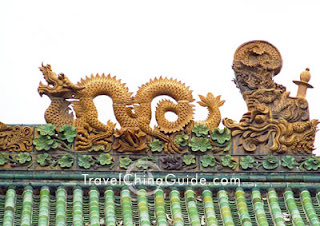
 Per popluar request, this is a lesson about the Chinese dragon. Sources are pulled from the internet including Wikipedia.com as well as Travelchinaguide.com. Enjoy!
The Chinese dragon is a Chinese mythical creature, depicted as a long, scaled, snake-like creature with four claws. In contrast to the Western dragon which stands on four legs and which is usually portrayed as evil, Chinese dragon has long been a potent symbol of auspicious power in Chinese folklore and art. The Chinese dragon is traditionally also the embodiment of the concept of yang (male) and associated with the weather as the bringer of rain and water in an agriculturally water-driven nation. Its female counterpart is the Pheonix.

The dragon is sometimes used in the West as a national emblem of China. However, this usage within both the People's Republic of China and the Republic of China on Taiwan is rare.
Firstly, the dragon was historically the symbol of the Emperor of China. Starting with the Yuan Dynasty, regular citizens were forbidden to associate themselves with the symbol. The dragon re-emerged during the Qing Dynasty and appeared on national flags.[1]
Secondly, the dragon has aggressive, warlike connotations that the Chinese government wishes to avoid. It is for these reasons that the giant panda is far more often used within China as a national emblem than the dragon. In Hong Kong, however, the dragon is part of the design of Brand Hong Kong, a symbol used to promote Hong Kong as an international brand name[2].
Many Chinese people often use the term "Descendants of the Dragon" (龍的傳人) as a sign of ethnic identity. Though this trend only started when different Asian nationalities were looking for animal symbols for representations in the 1970s. The wolf was used among the Mongols, the monkey among Tibetans.[1]
In Chinese culture today, it is mostly used for decorative purposes. It is a taboo to disfigure a depiction of a dragon; for example, an advertisement campaign commissioned by Nike, which featured the American basketball player LeBron James slaying a dragon (as well as beating up an old Kung Fu master), was immediately censored by the Chinese government after public outcry over disrespect.[3]
A number of Chinese proverbs and idioms also feature references to the dragon, for example: "Hoping one's son will become a dragon" (望子成龍, i.e. be as successful and powerful as a dragon).
For information on Western Dragons take a look at the below websites:
http://en.wikipedia.org/wiki/Dragon
http://www.crystalinks.com/dragons.html
Lesson 12 - 你多大?
Learning to say, "How old are you?" is very easy in Chinese. It is pronounced: Ni3 duo1 da? which literally means: You many years old? The characters are below:
Question: 你多大?
Answer: 我十五岁。
The answer is just as easy after you have learned how to say your numbers. Simply put in the subject "I" which is 我 (wo3) and then the number of years followed by the character 岁 (sui4) which means years old. One can also ask about other people per the below example:
Question: 你的爷爷多大? How old is your grandfather?
Answer: 我的爷爷八十四岁。 My grandfather is eighty four years old.
Practice asking about other people in the family and/or friends.
Question: 你多大?
Answer: 我十五岁。
The answer is just as easy after you have learned how to say your numbers. Simply put in the subject "I" which is 我 (wo3) and then the number of years followed by the character 岁 (sui4) which means years old. One can also ask about other people per the below example:
Question: 你的爷爷多大? How old is your grandfather?
Answer: 我的爷爷八十四岁。 My grandfather is eighty four years old.
Practice asking about other people in the family and/or friends.
Monday, September 17, 2007
Lesson 11 - 中秋节快乐。
It's that time of year again.... we're nearing the 15th day of the 8th lunar month (this year the full moon falls on Sept. 26th). This day in China is a popular holiday called: Mid-Autumn's Festival. It is a time of reunion and a night of moon gazing and munching on moon cakes. In Chinese we say:
中秋节快乐! zhong1 qiu1 jie2 kuai4 le4.
Happy Mid-Autumn Festival!
There is a famous legend of Chang e. The Earth had 10 suns in ancient times and Chang e's husband was a famous archer who shot down 9 in one shot, thus saving the people from famine. A goddess gave him an elixir, but Chang e drank it when he was out one day. She began to float up to the moon with only her rabbit for company. To this day the full moon, Chang e and rabbits are all associated in Chinese folklore.
Happy Festival! Eat lots of moon cakes.
中秋节快乐! zhong1 qiu1 jie2 kuai4 le4.
Happy Mid-Autumn Festival!
There is a famous legend of Chang e. The Earth had 10 suns in ancient times and Chang e's husband was a famous archer who shot down 9 in one shot, thus saving the people from famine. A goddess gave him an elixir, but Chang e drank it when he was out one day. She began to float up to the moon with only her rabbit for company. To this day the full moon, Chang e and rabbits are all associated in Chinese folklore.
Happy Festival! Eat lots of moon cakes.
Sunday, September 16, 2007
Lesson 10 - 两个苹果。
This lesson expored measure words. These are particles in a sentence that are similar to the English remnents: bottles, loaves, pairs... They are something we put before a noun to distinguish its number. ( Ex: I have 2 pairs of pants.)
我有三个好朋友。 wo3 you3 san1 ge hao3peng2you3.
I have 3 good friends.
他有两个书包。 Ta1 you3 liang3 ge shu1 bao1.
He has 2 bookbags.
There are other measure words besides 个. They include but are not limited to 杯,瓶, 碗, 座, 只,个 and many more. Some examples follow.
我有一杯水。 wo3 you3 yi1 bei1 shui3.
I have 1 glass of water.
他有六瓶可乐。ta1 you3 liu4 ping2 ke3le4.
He has 6 bottles of Cola.
Until next time. Peace.
我有三个好朋友。 wo3 you3 san1 ge hao3peng2you3.
I have 3 good friends.
他有两个书包。 Ta1 you3 liang3 ge shu1 bao1.
He has 2 bookbags.
There are other measure words besides 个. They include but are not limited to 杯,瓶, 碗, 座, 只,个 and many more. Some examples follow.
我有一杯水。 wo3 you3 yi1 bei1 shui3.
I have 1 glass of water.
他有六瓶可乐。ta1 you3 liu4 ping2 ke3le4.
He has 6 bottles of Cola.
Until next time. Peace.
Monday, September 10, 2007
Lesson 9 - 你们都学汉语吗?
In today's lesson, we covered the use of ye3 也 and dou1 都。 These characters are used right after the subject in a sentence. We used them with questions for practice:
你们都没有纸吗? Don't you all have paper?
他们也学汉语吗? Do they all study Chinese?
For review before the exam please practice the below relationship related words.
哥哥 ge1ge Older Brother
弟弟 di4di Younger Brother
妈妈 Ma1ma Mother
爸爸 Ba4ba Father
爷爷 Ye2ye Grandfather
奶奶 Nai3nai Grandmother
Also for the exam you should be able to write the numbers from 1 to 100, recognize the characters we've discussed and all of their meanings and how to use them in a sentence.
要努力学习!
你们都没有纸吗? Don't you all have paper?
他们也学汉语吗? Do they all study Chinese?
For review before the exam please practice the below relationship related words.
哥哥 ge1ge Older Brother
弟弟 di4di Younger Brother
妈妈 Ma1ma Mother
爸爸 Ba4ba Father
爷爷 Ye2ye Grandfather
奶奶 Nai3nai Grandmother
Also for the exam you should be able to write the numbers from 1 to 100, recognize the characters we've discussed and all of their meanings and how to use them in a sentence.
要努力学习!
Sunday, September 9, 2007
Lesson 8 - 他们是我的朋友。
Today we put some of our previous lessons together to create full sentences. We used the plural by adding the character 们 and we created some possessives by using 的 both in the same sentence. Example:
They are my friends.
他们是我的朋友。
ta1 men2 shi4 wo3 de peng2 you3.
She is their teacher.
她是他们的老师。
ta1 shi4 ta1men2 de lao3shi1.
We also explored some of the websites listed on the left.
For my students convenience I have listed the past homeworks that should have been completed and handed in. If you were absent or need to turn in late work, please refer to the below list and get them to me AS SOON AS POSSIBLE!
Assignment Characters
1.) 你好叫我。
2。) 我叫王家明。
3。) 老师学生。
4。) 他她你我是。
5。) Chinese News Articles
6。) 明名小校。
7。) 朋友的书。
8。) 学校校长。
9。) 玉龙中国。
10。) 不也大网。
11。) 教练汉语。
12。) 高中同学。
13。) 妈爸打球。
14。) 心的爱,请。
15。) Philosophy Papers - China
16。) Numbers from 1 to 100 in Chinese.
16。) 我有一个朋友。
17。) 他没有妹妹。
They are my friends.
他们是我的朋友。
ta1 men2 shi4 wo3 de peng2 you3.
She is their teacher.
她是他们的老师。
ta1 shi4 ta1men2 de lao3shi1.
We also explored some of the websites listed on the left.
For my students convenience I have listed the past homeworks that should have been completed and handed in. If you were absent or need to turn in late work, please refer to the below list and get them to me AS SOON AS POSSIBLE!
Assignment Characters
1.) 你好叫我。
2。) 我叫王家明。
3。) 老师学生。
4。) 他她你我是。
5。) Chinese News Articles
6。) 明名小校。
7。) 朋友的书。
8。) 学校校长。
9。) 玉龙中国。
10。) 不也大网。
11。) 教练汉语。
12。) 高中同学。
13。) 妈爸打球。
14。) 心的爱,请。
15。) Philosophy Papers - China
16。) Numbers from 1 to 100 in Chinese.
16。) 我有一个朋友。
17。) 他没有妹妹。
Monday, September 3, 2007
Lesson 7 - 他们的朋友。
今天我们学会了用“们”还有“的”。
Today we learned to use 们 men2 to make nouns plural. Just add the character 们 after a noun and it changes from singular to plural. Example:
我 becomes 我们
I becomes We
他 becomes 他们
He becomes They
We also learned to make write in the possesive. In English we add 's to the end of a noun to make it show ownership. In Chinese we add the character 的 de. Examples:
我 becomes 我的
I becomes my, mine
你 becomes 你的
You becomes Your
Putting the to things we learned together we can make a sentence like, "We are your students."
我们是你的学生。
wo3 men2 shi4 ni3 de xue2 sheng1.
Have fun with this. The Chinese language is really quite simple. Eventually, you'll wish you had learned it instead of English as a child.
好好玩!再见!
Today we learned to use 们 men2 to make nouns plural. Just add the character 们 after a noun and it changes from singular to plural. Example:
我 becomes 我们
I becomes We
他 becomes 他们
He becomes They
We also learned to make write in the possesive. In English we add 's to the end of a noun to make it show ownership. In Chinese we add the character 的 de. Examples:
我 becomes 我的
I becomes my, mine
你 becomes 你的
You becomes Your
Putting the to things we learned together we can make a sentence like, "We are your students."
我们是你的学生。
wo3 men2 shi4 ni3 de xue2 sheng1.
Have fun with this. The Chinese language is really quite simple. Eventually, you'll wish you had learned it instead of English as a child.
好好玩!再见!
Thursday, August 30, 2007
Lesson 6 - 她是学生吗?
In today's lesson we put some little things together to create sentences and questions in the positive and negative.
她是学生吗?
不,她不是学生。她是老师。
or.....
是,她是老师。
In English the above sentences are:
Is she a student?
No, she is not a student. She is a teacher.
and then......
Yes, she is a teacher.
We also covered stroke order and names of strokes for writing characters. We are unable to post this on this blog format at this time.
她是学生吗?
不,她不是学生。她是老师。
or.....
是,她是老师。
In English the above sentences are:
Is she a student?
No, she is not a student. She is a teacher.
and then......
Yes, she is a teacher.
We also covered stroke order and names of strokes for writing characters. We are unable to post this on this blog format at this time.
Subscribe to:
Posts (Atom)


